
The short version
- A BTU is a rate, not a total. The number printed on a gas fire pit is BTU per hour, the heat released while the burner runs, not a fixed reserve of heat.
- Bigger is not automatically warmer. All propane and natural gas flames burn at roughly the same temperature. A higher BTU rating means more total heat and a larger flame, not a hotter one.
- Outdoor sizing runs higher than indoor sizing. Open air and wind strip heat away before it reaches you, so a patio needs a higher BTU rating than an enclosed room of the same square footage.
- Tank runtime is simple math once you know the fuel's heat content. A full 20 pound propane tank holds about 430,000 BTU total, so dividing that by the burner's rating gives an honest runtime estimate.
- Natural gas never runs out, but it is not free. A therm is 100,000 BTU by definition, which is the number your gas bill is actually built on.
Section oneWhat a BTU actually means
The unit shows up on every gas fire pit box, and almost nobody buying one knows what it is actually measuring.
A British thermal unit is a measure of heat energy. The U.S. Energy Information Administration defines it as the quantity of heat required to raise the temperature of one pound of liquid water by one degree Fahrenheit. That is the entire definition. It has nothing to do with fire pits specifically, and everything to do with a standardized way of comparing how much energy any fuel contains, whether that fuel is propane, natural gas, gasoline, or a piece of firewood.
What confuses most buyers is the difference between a BTU and a BTU per hour. A fire pit's spec sheet lists a BTU per hour rating, sometimes just written as BTU, which describes the rate of heat the burner releases while it runs at full output. It is closer to horsepower than it is to a gas tank's total capacity. A 50,000 BTU burner does not contain 50,000 BTU of heat sitting in reserve. It releases heat at a rate of 50,000 BTU for every hour it runs, which is why the same number that describes how warm a fire pit feels also determines how long a tank of fuel will last, covered later in this guide.
Signature diagram
What one BTU actually does
Why it matters for a fire pit
The BTU rating on a burner box is a rate of energy release, not a stockpile. A 50,000 BTU burner releases heat fast enough to raise fifty thousand pounds of water by one degree in an hour, if all of that heat went into water instead of open air.
Outdoors, none of that heat is contained the way it would be in a sealed room, which is the entire reason outdoor BTU sizing charts run higher than indoor ones for a comparable square footage. More on that in the sizing and heat radius sections below.
Source: U.S. Energy Information Administration, British thermal units explained.
Section twoHow much heat is actually in your fuel
Propane, natural gas, and wood are sold in completely different units, which makes them impossible to compare at a glance. Converted to BTU, the comparison gets simple.
The Energy Information Administration publishes standardized heat content factors for common fuels so that gallons, cubic feet, and cords can all be measured on the same scale. Its published factors put propane at 91,452 BTU per gallon, natural gas at 1,036 BTU per cubic foot, and a cord of wood at roughly 20 million BTU, with the wood figure flagged as an estimate since a cord is a volume measurement that does not account for species or moisture content.
| Fuel | Unit sold | Heat content | Notes |
|---|---|---|---|
| Propane | 1 gallon | 91,452 Btu | The fuel behind portable pits and most fire pit tables |
| Propane | 1 cubic foot (vapor) | 2,516 Btu | Used for comparing propane and natural gas burner ratings |
| Natural gas | 1 cubic foot | 1,036 Btu | The fuel behind plumbed, built in fire pits |
| Natural gas | 1 therm | 100,000 Btu | Defined unit, this is what your gas utility bills by |
| Wood | 1 cord | About 20,000,000 Btu | EIA estimate, varies significantly by species and moisture |
Sources: EIA, British thermal units explained and EIA, Today in Energy, heat content of natural gas and natural gas liquids.
Notice that propane, gallon for gallon, is far denser in stored energy than natural gas is, cubic foot for cubic foot. That is exactly why a portable propane pit can run for hours off a tank small enough to carry with one hand, while a natural gas fire pit needs to stay plumbed into a continuous line rather than storing fuel on site at all. Neither fuel is more efficient in a meaningful sense. They are simply delivered differently, and that delivery method is the real decision behind choosing one over the other, covered in our propane versus natural gas comparison.
Section threeSizing BTU output to your patio
This is the number that actually determines whether a fire pit feels warm enough, and it has nothing to do with how big the burner looks in a product photo.
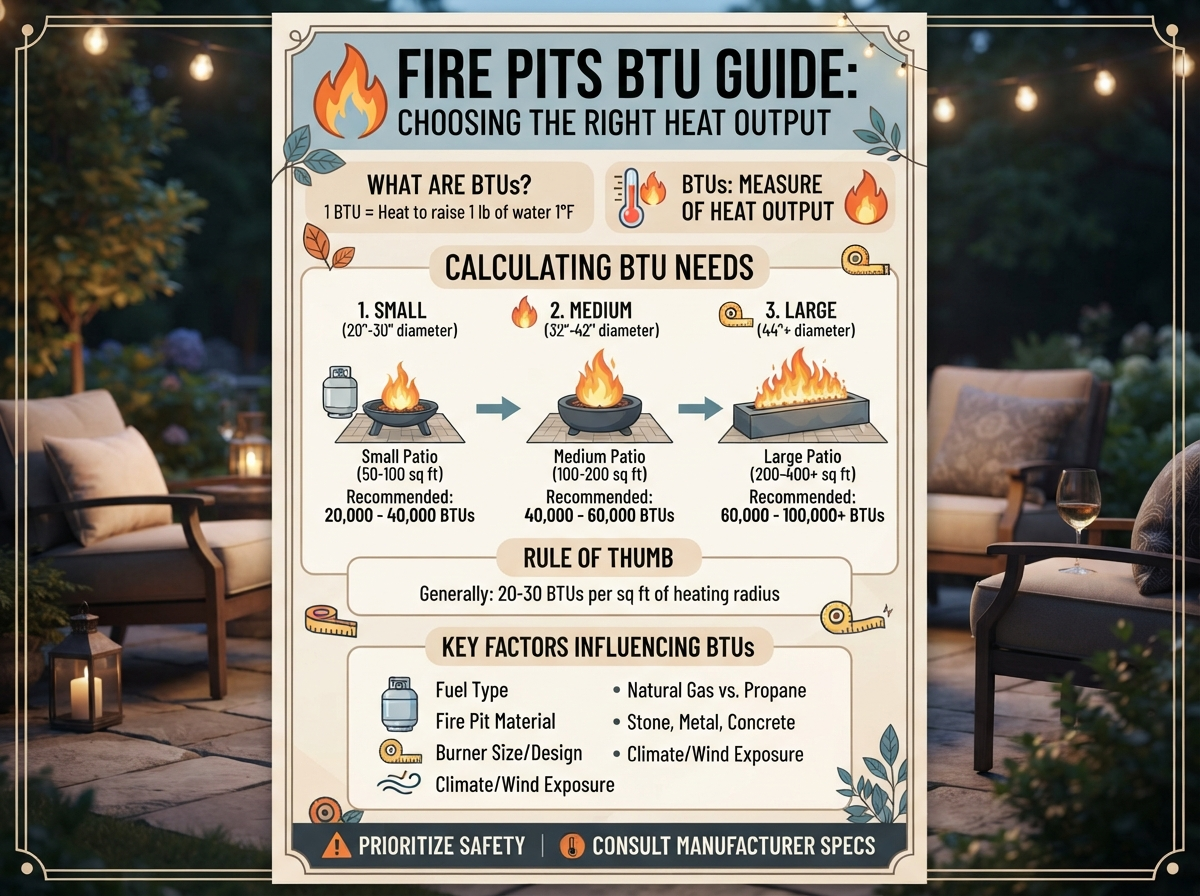
There is no single government standard for sizing an outdoor fire pit the way there is a defined clearance distance in the fire code. What exists instead is a practical range that scales with the area you are actually trying to warm, drawn from how gas burners perform in open air rather than in a sealed room. The chart below is the sizing frame we use throughout this site, treated as a starting range rather than an exact target, since wind, seating layout, and how close people sit to the flame all shift the real answer.
Chart
Recommended output by patio size
Portable propane pits generally fall between 14,000 and 40,000 BTU. Permanent gas installations reach 50,000 to 150,000 BTU or more. Treat this as a sizing frame rather than a fixed spec, since manufacturer ranges vary.
The pattern in that chart is not linear, and that is intentional. Doubling the square footage does not simply double the required BTU, because a fire pit heats a radius around itself rather than an enclosed volume. Past a certain distance from the flame, additional BTU output helps less than repositioning seating closer in, which is the reasoning behind the next section.
Section fourHeat radius, wind, and why outdoor math is different
The single biggest mistake in fire pit sizing is borrowing the math used to size an indoor furnace or space heater and applying it outside.
Indoor heating rules of thumb assume a sealed volume of air that a furnace or space heater is warming and holding at temperature, with insulation and walls preventing that heat from escaping. A patio has none of those conditions. Heat radiates outward from a fire pit and is carried away by any air movement almost immediately, which is why a fire pit rated for a given BTU output will feel noticeably weaker outdoors than a space heater with the same rating would feel indoors.
What actually determines how warm a fire pit feels is the radiant heat radius, the rough distance from the flame at which a person still feels meaningful warmth. That radius grows with BTU output, but not in a straight line, and it shrinks fast in wind. This is a general concept rather than a precise physical measurement, since burner design, flame height, and ambient temperature all change the real number, but the relative pattern below is a useful way to think about why bigger burners exist for bigger gatherings.
Concept diagram
Comfortable heat radius grows with output, roughly
Illustrative concept, not a measured specification. Wind, ambient temperature, and burner design all shift the real radius. A steady breeze can strip away a large share of the felt heat from any outdoor burner regardless of BTU rating.
This is also why the NFPA's fire pit safety guidance and model fire code clearance rules matter as much as BTU sizing does. A larger burner does not just warm a wider radius, it also throws more heat toward whatever sits at the edge of that radius, which is exactly why NFPA educational guidance recommends a minimum of 10 feet from anything that can burn, separate from the sizing question entirely. See our fire pit safety and clearance guide for the full distance requirements.
Section fiveTypical BTU ranges by fire pit type
Not every category of fire pit even has a BTU rating, which is worth knowing before you go looking for one on the box.
| Type | Typical BTU | Has a BTU rating | Notes |
|---|---|---|---|
| Open wood bowl | Not rated | No | Output depends on wood species, moisture, and fire size |
| Smokeless double wall, wood | Not rated | No | Same as above, secondary combustion changes smoke, not a BTU spec |
| Portable propane pit | 14,000 to 40,000 | Yes | Sized for one to two 20 lb tanks worth of runtime |
| Propane or natural gas fire table | 30,000 to 65,000 | Yes | The most common range for furniture-style fire tables |
| Built in natural gas | 50,000 to 150,000+ | Yes | Permanent installs plumbed to a continuous gas line |
| Wood pellet pit | Not rated | No | Output depends on pellet feed rate and burn stage |
| Gel or ethanol tabletop | Low, rarely stated | Sometimes | Ambiance level heat, not a meaningful patio heat source |
Ranges are typical manufacturer specifications across the category and vary by individual product. Always check the specific unit's listed output before buying.
Section sixHow long a propane tank actually lasts
This is simple arithmetic once you know two numbers: how much energy is in the tank, and how fast the burner uses it.
A standard 20 pound propane cylinder holds roughly 4.7 gallons of liquid propane when filled to its safe capacity. Multiplied by the EIA's heat content factor of 91,452 BTU per gallon, that works out to approximately 430,000 BTU of total stored energy in a full tank. Divide that figure by a burner's rated BTU per hour, and the result is an honest estimate of runtime at full output.
430,000 Btu ÷ burner rating (Btu per hour) = estimated runtime at full output
Chart
Estimated runtime on a full 20 lb tank, by burner size
Calculated from a full 20 lb cylinder at approximately 430,000 total Btu, using the EIA propane heat content factor of 91,452 Btu per gallon, run at full output. Running the flame at a lower setting stretches every one of these figures considerably, and real world tank fill levels vary. Source: EIA, British thermal units explained.
Two things follow directly from this math. First, a larger burner is not automatically a better value on fuel, since a 90,000 BTU pit burns through the same size tank almost three times faster than a 30,000 BTU pit does. Second, dialing the flame down to a medium setting rather than running wide open is the single easiest way to stretch a tank through a longer evening, since fuel consumption scales directly with how much of the rated BTU output the burner is actually using at any given moment.
Section sevenThe natural gas cost math
A plumbed natural gas fire pit never runs out mid evening, but it is not running for free, and the cost per hour is a straightforward calculation.
Because a therm is defined as exactly 100,000 BTU, converting a burner's hourly output into an hourly cost only requires your local utility's price per therm, which appears on every gas bill. The formula scales directly.
Example: a 60,000 Btu burner ÷ 100,000 = 0.6 therms per hour
Local natural gas prices vary significantly by region and by season, so this guide intentionally does not quote a single national number. Your own utility bill already lists a current price per therm, and plugging that figure into the formula above gives an accurate, current cost per hour for any burner size you are considering. What stays constant regardless of local price is the relative comparison: a 90,000 BTU built in fire pit costs exactly 1.5 times as much per hour to run as a 60,000 BTU unit, at any gas rate.
Check before you buy
A larger BTU rating on a natural gas installation is also a larger, permanent commitment, since the unit is plumbed to a fixed line rather than swapped like a propane tank. Confirm the gas line and regulator installed at the property can actually support the burner's rated draw before purchasing a high output built in unit, and have the connection sized and installed by a licensed professional.
Section eightThe mistakes that lead to buying the wrong BTU
Applying indoor heating math outdoors
Indoor heating rules of thumb, the kind used to size a furnace or a space heater to a room's square footage, assume a sealed volume of air. A patio is not a sealed volume of air. Using an indoor BTU per square foot rule to size a fire pit consistently under-buys the output needed, which is exactly why the outdoor sizing chart in this guide runs higher than typical indoor charts for a comparable square footage.
Buying the biggest number on the shelf
A bigger burner is not a better burner by default. Beyond a certain point for a given patio size, additional BTU output mostly means faster fuel consumption and a fire pit that runs uncomfortably hot for anyone sitting near it, not meaningfully more warmth for people at the edge of the seating area. Match the range in the sizing chart to the actual space rather than defaulting to the highest number available.
Ignoring wind entirely
A fire pit sized correctly for a sheltered courtyard will underperform on an open, exposed patio with the exact same square footage, because wind carries radiant heat away before it reaches anyone. If the space is regularly breezy, sizing toward the top of the recommended range, or adding a wind break, matters more than any other single adjustment.
Forgetting that clearance rules do not scale with BTU
Fire code clearance distances are set by unit type, not by how large the burner is. A 90,000 BTU fire pit and a 30,000 BTU fire pit are held to the same minimum distance from a structure under model fire code, even though the larger unit throws considerably more heat toward that structure. Bigger output does not buy you a smaller required setback. See our distance from a house guide for the exact figures.
Section nineFrequently asked questions
What is a BTU in simple terms?
A British thermal unit is the amount of heat needed to raise the temperature of one pound of water by one degree Fahrenheit, according to the U.S. Energy Information Administration. For a fire pit, the BTU rating printed on a gas burner is a per hour figure. It tells you how much heat energy the burner releases in one hour running at full output, not a fixed total amount of heat.
How many BTUs does a fire pit need?
Match output to the space rather than buying the largest burner available. Roughly 30,000 to 50,000 BTU suits a small patio near 150 square feet, 50,000 to 70,000 BTU suits a mid size patio near 250 square feet, and open or windy areas benefit from 90,000 BTU or more. Portable propane pits typically run 14,000 to 40,000 BTU, while permanent gas installations reach 50,000 to 150,000 BTU or higher.
Does a higher BTU rating mean a hotter flame?
No. BTU per hour measures the rate of heat energy released, not flame temperature. A propane and a natural gas flame both burn in roughly the same 800 to 1,200 degree Fahrenheit range regardless of BTU rating. A higher BTU burner produces more total heat and a larger flame, which covers a wider area and feels warmer at a given distance, but it does not burn at a higher temperature at the flame itself.
How long does a 20 pound propane tank last on a fire pit?
A standard 20 pound cylinder holds roughly 4.7 gallons of propane, and the EIA lists propane's heat content at 91,452 BTU per gallon, for a full tank total of about 430,000 BTU. Divide that by the burner's rated BTU per hour to estimate runtime: a 30,000 BTU burner runs about 14 hours, a 50,000 BTU burner about 8.6 hours, and a 90,000 BTU burner under 5 hours, all at full output. Running the flame lower stretches these figures considerably.
Is wood or gas more efficient for heat output?
Wood contains more total energy for its bulk than most people expect. The EIA estimates a cord of seasoned wood at roughly 20 million BTU, though this figure varies significantly by species and moisture content and is not directly comparable to a burner's BTU per hour rating, since an open wood fire has no fixed output the way a regulated gas burner does. Gas is more efficient in the sense that its output is controllable, consistent, and fully combusted, while wood loses real energy to excess smoke when it is unseasoned or the fire is smothered.
Why does my fire pit not feel as warm as its BTU rating suggests?
Outdoor radiant heat is not contained the way indoor furnace heat is, so wind, open air, and distance all reduce how much of a burner's rated output actually reaches a person sitting nearby. A fire pit that would comfortably heat an enclosed room at its BTU rating will feel noticeably weaker outdoors in any breeze, which is why outdoor BTU sizing charts run higher than indoor heating charts for a comparable square footage.
Keep readingRelated guides
How we research
The figures in this guide come from primary sources rather than secondhand blog math. Heat content values for propane, natural gas, and wood are drawn directly from the U.S. Energy Information Administration. Clearance and safety context comes from the International Fire Code and NFPA educational guidance. Where a figure is a sizing convention rather than a fixed standard, such as the patio size chart, we say so rather than presenting it as an official spec.
Learn more about how we test and who we are.