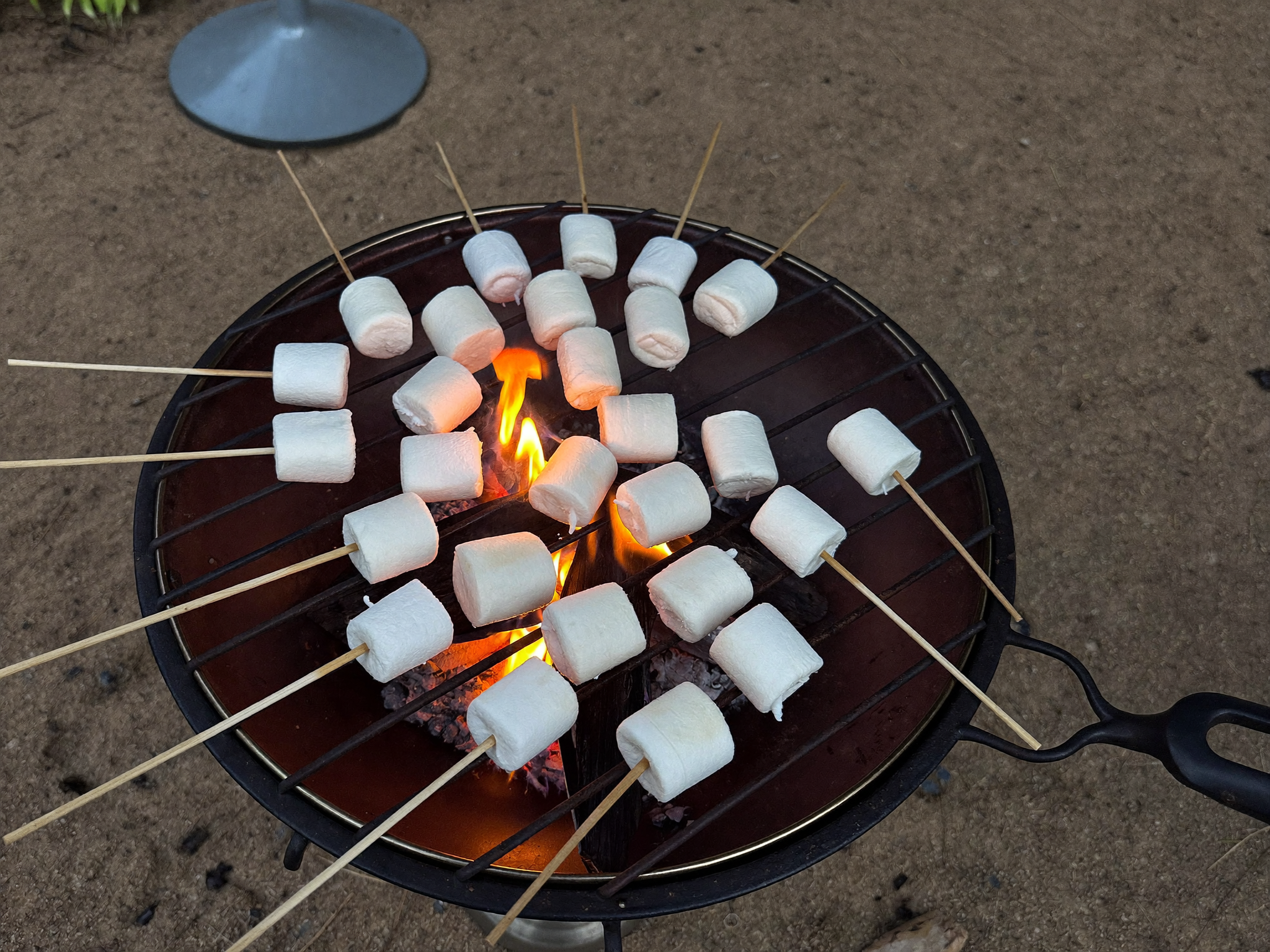
Propane and natural gas both burn to carbon dioxide and water vapor with no flavor transfer, the same chemistry that makes a gas grill possible. The adjustment is technique: a propane flame runs hotter and more consistent than wood, so the marshmallow needs to be held further back and the valve dialed to medium, not wide open.
Why propane doesn't leave a taste
Every time you grill a steak over gas, you are cooking over the same fuel as a propane fire pit. The reason your steak doesn't taste like a gas station comes down to combustion chemistry.
Complete combustion of propane
One molecule of propane plus five of oxygen produces three of carbon dioxide and four of water vapor. Neither has a flavor, and neither sticks to food.
Wood smoke is different. A burning log releases hundreds of aromatic compounds, many of which are volatile phenols and carbonyls that deposit on whatever sits above the flame. That's the campfire flavor. Propane combustion produces none of those compounds when it burns completely.[1]
What some people interpret as a "gas taste" is almost always one of two things: the odorant added to propane for leak detection, called ethyl mercaptan, which burns off within the first minute or two of a lit flame, or incomplete combustion from a partially blocked burner. A clean, well-maintained fire pit running on a full propane supply burns completely and leaves nothing behind.[2]
Propane burns hotter than you expect
The single biggest reason marshmallows scorch over a gas fire pit is that people use campfire instincts on a hotter, more direct flame. Here's how the temperatures compare.
A propane or natural gas flame runs nearly twice as hot at the point of combustion as a typical campfire coal bed. That's why the standard campfire technique of holding a marshmallow 6 to 8 inches above the glow tends to produce an immediate black char over gas. The fix is simple: back off to 8 to 11 inches and dial the valve to medium.
Roasting distance by fuel type
Three things that change from wood to gas
A propane flame is a steady, directed jet rather than a fluctuating coal bed. The heat zone is narrower and hotter, which means a marshmallow held at campfire distance scorches on the outside before the center has time to soften.
Melted marshmallow that falls into a lava rock or fire glass media bed can clog the small burner ports underneath, causing uneven or sputtering flames. Some manufacturers note that cooking residue can void warranties on certain units.
Most gas fire pits let you dial the output. Medium is the roasting sweet spot: enough heat to cook the marshmallow through without the violent char that comes from a wide-open valve.
The technique, step by step
The USDA's grilling guidance notes that gas-fueled cooking surfaces can brown food very quickly on the outside, which is why temperature awareness matters more over gas than over wood.[3] For marshmallows, that means working with the heat rather than against it.
| Step | What to do and why |
|---|---|
| 1Dial the flame to medium | A lower, steadier flame gives a longer window between raw and charred. Full open runs so hot that the outside blackens before heat penetrates to the center. |
| 2Use a long metal skewer | 18 inches or longer keeps hands well clear of radiant heat from the gas flame. Bamboo sticks work over wood but can catch fire much faster over a direct gas flame. |
| 3Position 8 to 11 inches above the burner | Further back than instinct suggests over wood. The outer edge of the flame column is where even browning happens. The core of a gas flame is too intense for anything but charring. |
| 4Rotate slowly and continuously | Constant rotation through the outer heat zone gives uniform color instead of one flat-scorched face. |
| 5Pull before it looks done | Carryover heat continues cooking the interior for a few seconds after you pull back. The marshmallow will finish on its own. Waiting for it to look perfect over the flame always overshoots. |
Keep the burner clean
Gas fire pits are not designed for cooking, and the media bed, whether lava rock or fire glass, sits directly above the burner ports. A dripped marshmallow that makes it through the media can plug those ports and cause an uneven, sputtering flame the next time you use the pit.[4] Two fixes cover it.
If drips do get through, the burner ports can usually be cleared with a soft brush or compressed air once the pit has cooled completely. See our fire glass vs lava rock guide for which media type is easier to clean after a cooking session.
How propane, natural gas, and wood compare for roasting
| Fuel type | Flavor transfer | Flame consistency | Roasting learning curve | Burner drip risk |
|---|---|---|---|---|
| Propane | None | Very even, controllable | Moderate (hotter than it looks) | Medium (media bed present) |
| Natural gas | None | Very even, controllable | Moderate (same as propane) | Medium (media bed present) |
| Wood campfire | Smoky, noticeable | Fluctuates with coals | Low (familiar intuition) | Low (open coal bed) |
| Smokeless wood pit | Mild smoke | Moderate, secondary ring adds complexity | Low to moderate | Low (open coal bed) |
| Wood pellet pit | Mild smoke | Even when fully stoked | Low | Low (open coal bed) |
About that sulfur smell when you first light the pit
Propane and natural gas are both naturally odorless. Gas utilities and suppliers add a compound called ethyl mercaptan specifically so people can detect a leak by smell.[5] The faint rotten-egg smell some people notice in the first minute or two after lighting a fire pit is that odorant burning off, not a byproduct of the fuel itself.
General safety that still applies
Roasting marshmallows over a propane fire pit does not change the fire safety rules that apply to any open flame outdoors. The USDA's fire safety resources for outdoor cooking emphasize that surface temperatures around an active gas flame can remain dangerously high even when the flame itself appears small.[3]
Frequently asked questions
Is it safe to roast marshmallows over a propane fire pit?
Will marshmallows taste like gas if roasted over propane?
How far should you hold a marshmallow above a propane fire pit?
Does roasting marshmallows damage a gas fire pit?
Can you roast marshmallows on a natural gas fire pit?
Can you roast marshmallows on a smokeless fire pit?
Sources
- Complete combustion of propane: C₃H₈ + 5O₂ → 3CO₂ + 4H₂O. Standard organic chemistry combustion equation, consistent across educational sources including CK-12 Foundation.
- Ethyl mercaptan as propane odorant: Ferrellgas, "What makes propane gas smell?"
- Gas grilling and surface temperature awareness: USDA Food Safety and Inspection Service, "Grilling Food Safely".
- Burner port clogging from food debris: Fire Pit Outfitter, "How to Clean a Gas Fire Pit".
- Ethyl mercaptan odorization of LP gas: CDC NIOSH, "Odor Fade in Natural Gas and Propane" (PDF).