

The short answer: plain, standard concrete masonry units are not designed for direct, repeated flame contact. They can work as an outer wall set back from the fire, but they are the wrong choice as the inner liner that actually touches flame.
Why concrete block reacts badly to fire
A standard cinder block, technically a concrete masonry unit, is porous by design. Those internal pores and voids readily absorb ambient moisture from rain, humidity, or contact with damp ground, and concrete itself cures with water locked into its chemical structure.
Research on concrete fire behavior, including a masonry fire-performance study published in the journal Fire and Materials, identifies moisture content as one of the primary factors driving spalling, alongside heating rate and how the resulting thermal stress interacts with trapped vapor pressure inside the block. The National Concrete Masonry Association's technical guidance on fire resistance confirms that moisture content is a recognized variable in how a concrete masonry unit performs when exposed to fire. In plain terms: when a fire heats the block's face faster than trapped moisture can migrate out through its pores, that moisture converts to steam, the pressure has nowhere to go, and a piece of the block's surface cracks and pops off, sometimes with enough force to send a fragment several feet.
The threshold that matters
Water boils and turns to steam at 212 degrees Fahrenheit, the same threshold researchers point to when explaining heat-induced concrete spalling. An open wood fire routinely pushes the surface of an adjacent block well past that point, and it can do it in minutes rather than hours. That is the entire mechanism: a fast trip past 212 degrees inside a material that has nowhere for the resulting steam to go.
Check a material before you build
Pick a material below to see whether it belongs on the inner liner, the outer wall, or off the build entirely.
Fire brick is manufactured for kilns and fireplace fireboxes, so it is built to handle direct, repeated flame contact without spalling. It is the safest material for anything touching the fire itself.
General material guidance, not an engineering assessment of any specific product or build.
What actually holds up
| Material | Direct flame contact | Notes |
|---|---|---|
| Fire brick | Yes, designed for it | The same material used to line kilns and fireplace fireboxes. The safest choice for anything that touches flame directly. |
| Steel fire ring insert | Yes | Drops inside any wall material and takes the direct heat itself, protecting whatever surrounds it. |
| Standard cinder block, CMU | No | Prone to spalling from trapped moisture. Usable as an outer wall a few inches back from flame, not as the liner. |
| Dense, low absorption concrete paver | Not recommended | Better than standard block but still not rated for direct flame. Same setback rule applies. |
| Natural fieldstone | Case by case | Some stone types handle heat well, others contain trapped moisture pockets similar to concrete block. Hard to predict without knowing the specific stone. |
Building it correctly
- Use a steel linerA round steel fire ring insert set inside the block wall is the single change that prevents most spalling incidents, since it keeps flame off the concrete entirely.
- Leave an air gap or sand bufferA gap of an inch or more, or a packed layer of sand, between the steel liner and the block wall insulates the block from residual radiant heat even with the liner in place.
- Store blocks dry before the first burnKeep new blocks off the ground and out of rain for at least a week before first use, since freshly delivered block can still be holding manufacturing moisture.
- Start smallThe first few fires should be modest ones. A slow ramp gives any residual moisture time to evaporate gradually instead of flashing to steam under a large fire.
- Set the wall on a compacted, well drained baseA gravel base under the wall, matching the approach in our sunken fire pit drainage guide, keeps ground moisture from wicking up into the block over time.
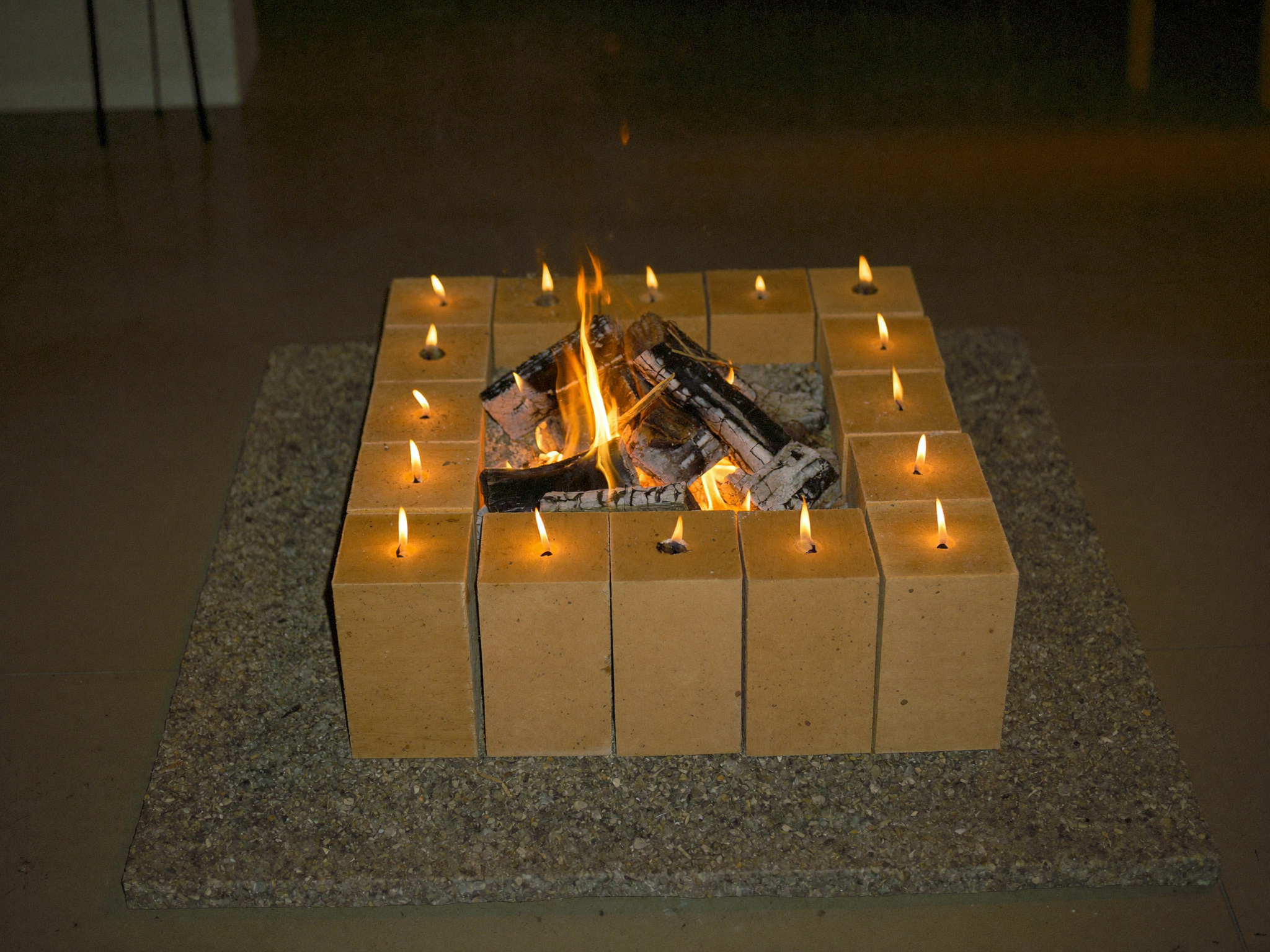
This is separate from clearance rules. Even a well built block fire pit still needs the same setback from structures and combustible material covered in our safety and clearance guide, and it still needs a spark screen if it is wood burning. If rust and weathering are a bigger concern than block choice for your build, our fire pit maintenance and rust prevention guide covers upkeep for the steel components.
Frequently asked questions
Can cinder blocks explode in a fire pit?
Yes. Standard concrete masonry units are porous and can hold trapped moisture inside their pores and voids. When a fire heats the block quickly, that moisture turns to steam faster than it can escape, and the pressure can crack or violently spall pieces off the block's face.
What kind of block is safe for a fire pit?
Fire brick, rated for direct flame contact in kilns and fireplaces, is the safest choice for the inner liner. Dense, fully cured concrete pavers with low water absorption hold up reasonably well as an outer retaining wall when kept a few inches back from direct flame contact.
How do I dry out cinder blocks before using them in a fire pit?
Store them somewhere fully dry, off the ground and out of rain, for at least a week before the first burn, then start with a small, low fire for the first use rather than a full sized one. This gives any residual moisture time to evaporate gradually instead of flashing to steam all at once.
Do I need a metal liner inside a cinder block fire pit?
It's the single most effective upgrade. A steel fire ring insert set inside the block wall, with an air gap or sand between the two, keeps direct flame contact off the block entirely and is what lets many builders get years out of an otherwise ordinary concrete block wall.
At what temperature does concrete start to spall?
Trapped moisture inside concrete converts to steam once it passes the boiling point, around 212 degrees Fahrenheit, and an open wood fire pit routinely exceeds that at the block's surface. Research on concrete fire behavior identifies moisture content, heating rate, and how tightly the steam pressure is trapped inside the material as the main factors that determine whether spalling occurs.