
Fit-first buying guide
Best fire pit covers: five picks that fit, stay put and keep water out
The fabric matters, but the measurements matter more. We compared five round and square covers by actual dimensions, coating, seams, ventilation and fastening so you can protect the pit without trapping moisture underneath.

Shape, width and height decide the fit. Coating, seams, vents and straps decide how well that fit survives weather.
Affiliate disclosure: FirePitSpot may earn a commission from qualifying purchases made through links on this page, at no extra cost to you. Product specifications are manufacturer-reported and can change. We did not conduct hands-on durability testing of these five covers, so our recommendations are based on documented fit, construction and protective features rather than invented test results.
The direct answer
The best fire pit cover is waterproof, correctly shaped, tall enough to cover the exposed body, vented or able to release trapped moisture, and secured by straps or a drawcord. For most 22 to 32-inch round bowls, the SHINESTAR Round offers the most balanced feature set. For a 33 to 36-inch full-height round pit, the SheeChung provides deeper 24-inch coverage. Measure before ordering, and never cover a fire pit until it is completely extinguished, cool and dry.
Quick comparison
Five fire pit covers, side by side
Start with the dimensions column. A feature-rich cover that is two inches too small is still the wrong cover.
| Cover | Listed size | Material and water barrier | Retention and airflow | Best fit |
|---|---|---|---|---|
| Best full-height round SheeChung Round |
36 in diameter × 24 in high | 600D polyester with PVC coating | Adjustable drawstring; vents not stated | Most 33 to 36-inch round pits that need deep coverage |
| Best overall round SHINESTAR Round |
32 in diameter × 13.5 in high | 600D polyester; waterproof backing | Built-in vents, fastening straps and drawcord | Most 22 to 32-inch round bowls and low pits |
| Best 36-inch low profile QH.HOME Round |
36 in diameter × 20 in high | 600D fabric with vinyl and PVC barrier; taped seams | Wind retention features stated by maker | Most 34 to 36-inch round bowls and tables up to 20 inches high |
| Broadest compact range WLEAFJ Round |
34 in diameter × 15 in high | 420D Oxford fabric with waterproof treatment | Click-close straps and adjustable drawstring | Round pits from 22 to 34 inches that stay under 15 inches high |
| Best square SHINESTAR Square |
32 × 32 × 24 in | 600D polyester with PVC and anti-UV coating | Side vents and two lower drawstrings | Most 28 to 32-inch square fire tables |
Listed fit ranges and features come from the linked manufacturer listings. Measure your exact model and read its manual before purchase.
Interactive tool
Find the closest match from these five covers
Enter the outside measurements
This selector compares your dimensions with the published sizes of the five covers on this page. It does not replace the fire pit manual or the cover maker's fit instructions.
Measure before buying
How to measure a fire pit for a cover
Use a rigid tape measure and measure the fire pit itself, not the box, burner opening or product nickname. Include fixed handles, control housings, raised lids and any other part that will sit under the cover.
Round fire pits
- Measure straight across the widest outside point through the center. This is the diameter.
- Measure from the highest fixed point to the lowest point that needs protection.
- Check whether a handle, spark screen or raised control housing changes either number.
Square and rectangular fire tables
- Measure the full outside length and width of the tabletop.
- Measure the height from the top surface to the lower edge you want covered.
- Include protruding controls and fixed handles. Do not measure only the burner tray.
Specification-based picks
The five best fire pit covers in this comparison
We ranked these covers by fit clarity, material system, seam protection, airflow and wind retention. We did not rank by temporary price, star rating or unsupported claims. If your measurements fall outside a product's stated range, skip it regardless of its position below.
SheeChung 36-inch round fire pit cover
The SheeChung is the deepest round cover here. Its 36-inch diameter and 24-inch height are useful for taller fire bowls and gas fire tables that would leave their lower body exposed under a 13.5 or 15-inch cover. The listed construction combines 600D polyester with a PVC coating, while an adjustable lower drawstring pulls the opening inward.
Choose this one when height is the deciding measurement. Do not choose it for a shallow 30-inch bowl just because it can physically go over the top. Excess fabric can flap and form low spots where water collects.
- Deepest round coverage in the group
- 600D face fabric with a separate water barrier
- Drawstring helps control the lower opening
- Vent panels are not stated in the listing
- Too tall for many low fire bowls
- Only makes sense if both diameter and height match
Best for: a round 33 to 36-inch fire pit that needs close to 24 inches of vertical coverage.
SHINESTAR round cover for 22 to 32-inch fire pits
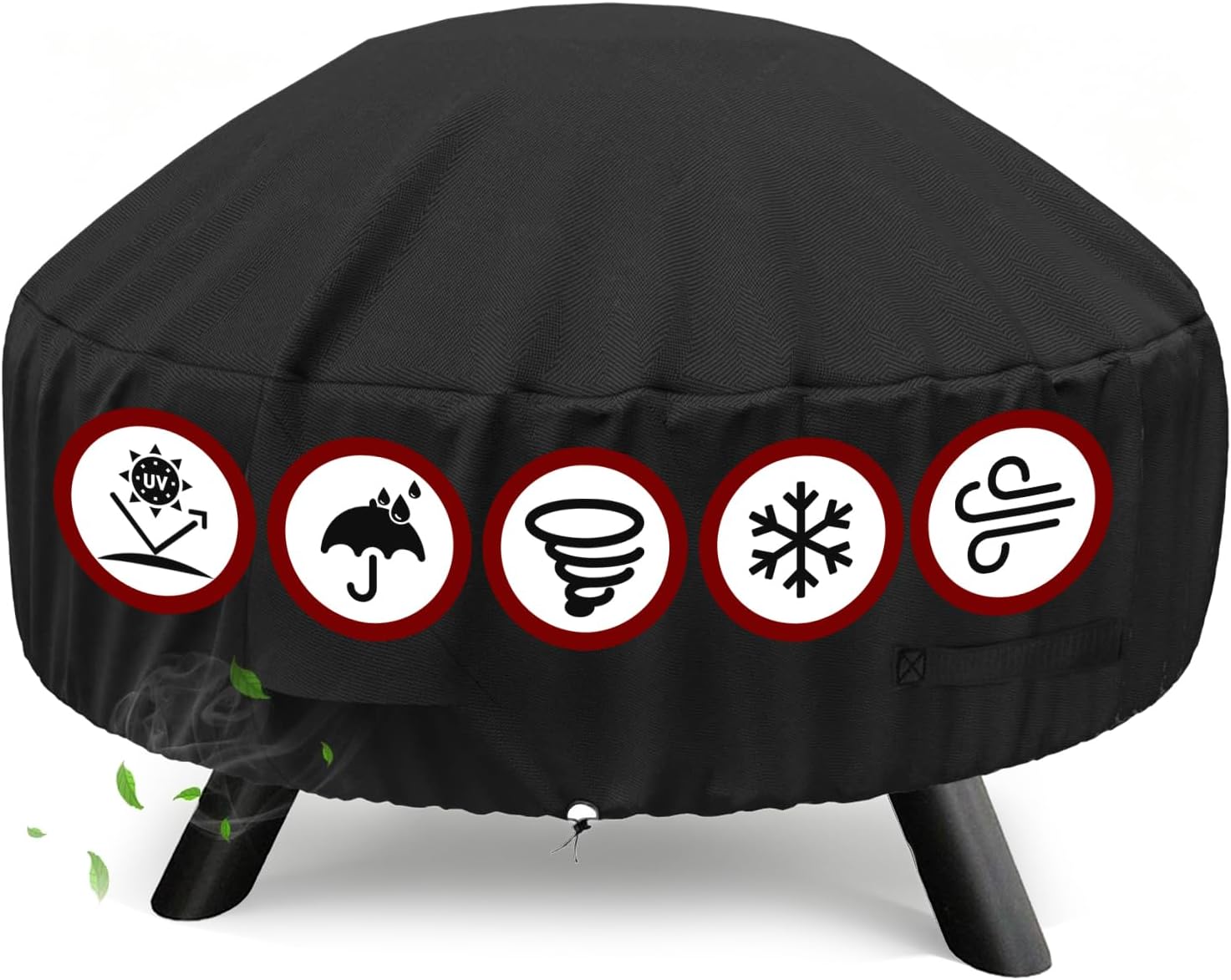
The SHINESTAR has the most complete feature balance for a common low round fire pit. The published finished size is 32 inches in diameter by 13.5 inches high. Built-in vents give damp air a route out, while lower straps and a drawcord address the two ways a light cover usually misbehaves: billowing and lifting.
This is not the right pick for a tall gas table, but it is the strongest starting point for a traditional low bowl. The shallower drop means less spare fabric around compact pits, and the airflow details are more convincing than a waterproof claim by itself.
- Built-in vents help release trapped humidity
- Straps and drawcord improve wind retention
- Published size is clear and easy to compare
- 13.5-inch height will not cover a tall table
- A loose fit is possible at the smallest end of the range
- Measure screens and handles, not just the bowl
Best for: a round 22 to 32-inch low bowl where ventilation and wind control matter.

QH.HOME 36-inch round fire pit cover
The QH.HOME fills the height gap between a low bowl cover and the full 24-inch SheeChung. It measures 36 inches across and 20 inches high, with a listed fit focused on 34, 35 and 36-inch round pits. The maker describes a 600D fabric shell, vinyl and PVC water barriers, heat-sealed waterproof tape at the seams and UV-focused face fabric.
The seam treatment is the important detail. Water often finds stitched openings before it passes through the middle of a coated panel. Treat the UV and waterproof percentages as manufacturer claims, not independent laboratory results, but the documented construction is still stronger evidence than the word waterproof alone.
- Useful 20-inch intermediate height
- Taped seams address a common leak path
- Narrower listed diameter range encourages a closer fit
- Too large for pits below the listed range
- Marketing percentages are not independent test results
- Confirm the current listing's wind-retention details
Best for: a 34 to 36-inch round fire pit that measures no more than 20 inches high.
WLEAFJ round cover for 22 to 34-inch fire pits
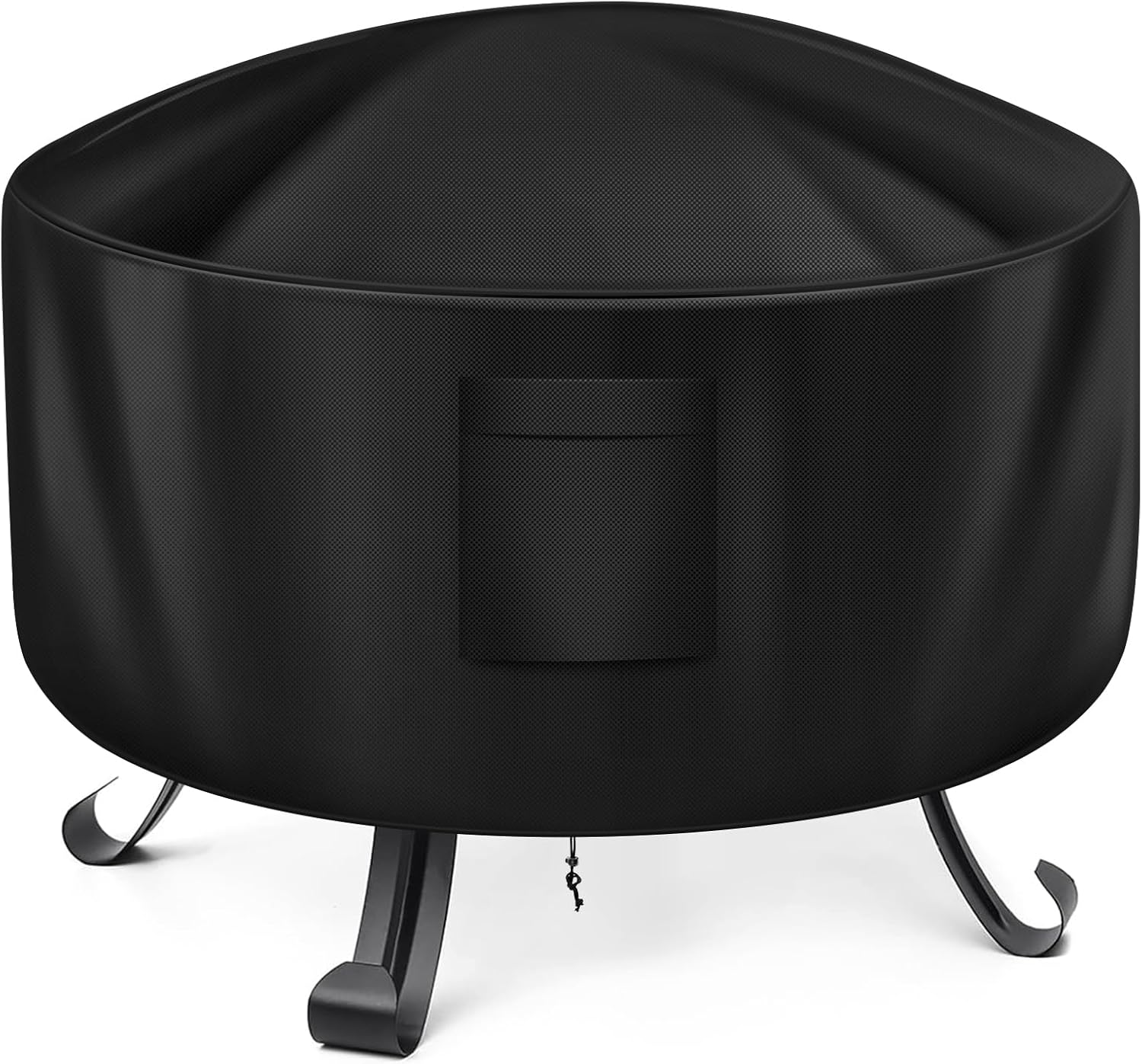
The WLEAFJ stretches the compact category to a 34-inch maximum while keeping the drop to 15 inches. Its listed 420D Oxford fabric is lighter than the 600D face fabrics elsewhere on this page, but the design adds click-close straps and an adjustable drawstring to keep the lower edge controlled.
Its advantage is range rather than maximum fabric weight. It can make sense for an unusual 33 or 34-inch low bowl that is too wide for the SHINESTAR Round but does not need 20 to 24 inches of vertical coverage. A lighter shell may also be easier to remove and fold, although it gives up some theoretical abrasion reserve.
- Covers compact diameters up to 34 inches
- Two types of lower retention
- 15-inch height suits many low bowls
- 420D is the lightest listed face fabric here
- A 22-inch pit may leave substantial loose fabric
- Vent panels are not the headline feature
Best for: a low round pit up to 34 inches when a 32-inch cover is too small.

SHINESTAR square cover for 28 to 32-inch fire tables
This is the only square-cut cover in the comparison, and that geometry matters. Pulling a round cover over a square table creates excess fabric at the sides and stress at the corners. The SHINESTAR measures 32 by 32 by 24 inches and is listed for most 28 to 32-inch square fire tables.
Its listed features include side vents, PVC and anti-UV coatings, sealed seams and two lower drawstrings. The 24-inch drop is suited to a table body rather than a shallow bowl. Measure both tabletop directions even if the product is described as square, since attached controls or uneven trim can change one dimension.
- Square pattern avoids corner stress and side slack
- Side vents release trapped moisture
- Two lower drawstrings improve retention
- Not for rectangular or oversize tables
- 24-inch drop may be excessive on a short square bowl
- Measure attached control housings carefully
Best for: a square fire table from 28 to 32 inches wide and no more than 24 inches high.
Material reality check
600D does not automatically mean waterproof
Denier is a unit of linear mass density for yarn. The National Institute of Standards and Technology defines it as grams per 9,000 meters of fiber. A higher number generally indicates a heavier yarn when the material and construction are comparable, but it does not tell you whether water can cross the finished cover. That depends on the coating, seams, wear and construction.
Face fabric
Polyester or Oxford fabric provides the woven structure. Heavier yarn can help with abrasion and tear reserve, but weave density and quality also matter.
Water barrier
PVC, vinyl or polyurethane coating creates the main barrier behind or on the fabric. A coating can fail at folds, scratches and aged sections.
Seams and vents
Stitch holes are potential water paths. Tape or sealing helps. Vents allow humid air to escape, but they must be shaped so wind-driven rain does not enter easily.
Why cover the pit at all? A NIST corrosion report notes that cracked coatings expose steel to air and water, with the most severe corrosion where moisture collects. A peer-reviewed review of carbon-steel corrosion also describes how moisture, salts and wet-dry cycles influence rust development. The practical lesson is simple: keep standing water away, maintain the pit's protective finish and avoid sealing existing moisture under fabric.
If the pit is already showing corrosion, use our fire pit maintenance and rust-prevention guide before covering it. A cover slows new exposure. It does not repair loose coating, clogged drainage or existing rust.
Buying priorities
What matters after the measurements
| Feature | Why it matters | What to look for | Warning sign |
|---|---|---|---|
| Water barrier | Keeps rain from reaching metal, ignition components and the burner pan | Named coating or backing, not just the word waterproof | No coating material or seam information |
| Seam treatment | Stitch holes can leak before the main panel does | Taped, sealed or protected seams | Flat top with unprotected center seams |
| Ventilation | Allows damp air and condensation to escape | Covered side vents or a manufacturer-approved lower airflow path | A wet pit sealed under an airtight cover |
| Wind retention | Stops the cover from lifting or rubbing repeatedly | Buckles, straps, elastic hem or adjustable drawcord | Loose hem with no attachment point |
| Top shape | Encourages rain to shed instead of collecting | A close fit over a lid or a supported crown | A large flat pocket where water can pool |
| UV protection | Reduces fading and polymer damage in direct sun | Documented UV-resistant fabric or coating | Thin uncoated fabric in full sun |
Avoid these failures
Seven fire pit cover mistakes that cause leaks, rust or returns
- Measuring the burner opening instead of the outside body. A 24-inch burner can sit inside a 32-inch table.
- Checking diameter but ignoring height. The round covers here vary by more than ten inches in vertical coverage.
- Covering a hot fire pit. Heat can damage coated fabric and create a fire hazard. Wait until every surface is cool.
- Sealing rainwater underneath. Wipe or air-dry the pit before installing the cover and keep drainage openings clear.
- Buying far too large for convenience. Excess fabric flaps, rubs the finish and creates pockets where water can collect.
- Relying on denier alone. A heavy face fabric with weak seams or no useful retention can still perform poorly.
- Ignoring the fire pit manual. Some manufacturers specify their own cover, storage method, ventilation or shutdown sequence.
A cover is only one part of safe ownership. Keep the pit outdoors and away from combustible materials, attend it while it is burning and extinguish it fully. The U.S. Fire Administration's outdoor fire guidance recommends keeping fire pits at least 10 feet from the home or anything that can burn. Local rules and the product manual may require more. Our fire pit safety and clearance guide explains how those distances change by fire type.
Connect the setup
Protect the whole fire pit, not just the top
Before buying, identify which kind of pit you own. A tall propane table, shallow wood bowl and double-wall smokeless pit need different cover proportions. Our propane fire pit table guide explains the parts hidden inside a gas table, while our wood-burning fire pit guide covers bowl materials and corrosion risks.
Make sure ash is cold and removed before covering a wood pit. Keep gas controls dry, but do not block required cabinet ventilation or drainage on a propane model. If the unit sits on a combustible surface, a cover does not make the installation safer. Read whether a fire pit can go on a deck, then follow the unit's listing and local rules.
For the other add-ons that genuinely change safety or service life, see our comparison of fire pit accessories worth buying. A fitted cover protects the pit between burns. A spark screen, long tools and the correct heat barrier protect the area while the fire is operating.
Direct answers
Frequently asked questions
Should you cover an outdoor fire pit?
Yes. Once the fire pit is fully extinguished, cool and dry, a fitted outdoor cover keeps rain, snow and debris away from the metal and burner components. Follow the fire pit manufacturer's instructions before covering it.
What size cover should I buy for my fire pit?
Measure the widest exterior diameter on a round pit, or the full length and width on a square or rectangular table. Measure from the highest fixed point to the lowest point you want covered. Compare every dimension with the cover maker's stated fit range.
Can I put a cover on a hot fire pit?
No. Extinguish or turn off the fire, close the fuel supply when applicable and wait until every surface is completely cool. Polyester, vinyl and PVC coatings can be damaged by heat and should never be placed over a live fire or hot pit.
Can a fire pit cover cause rust?
A cover can contribute to trapped condensation if it is installed over a wet pit and has no path for moisture to escape. Dry the pit first, keep drainage openings clear and choose vents or a small lower airflow gap where the manufacturer allows it.
Is 600D better than 420D for a fire pit cover?
600D uses heavier yarn than 420D when the fiber and construction are comparable, which can provide more abrasion and tear reserve. It is not automatic proof of waterproofing. Coating quality, seams, vents, fit and retention still determine real outdoor performance.
Should a fire pit cover touch the ground?
Usually no. The cover should protect the exposed body without dragging on the ground, collecting dirt or blocking drainage and required ventilation. Use the fire pit and cover manufacturers' instructions because gas tables can have specific cabinet-airflow requirements.
Can I use a round cover on a square fire pit?
It may pull over the top if it is oversized, but the fit will usually be poor. Square corners concentrate tension while extra fabric gathers between them. A square-cut cover such as the SHINESTAR Square gives cleaner coverage and better wind control when the dimensions match.
How do I stop water from pooling on a fire pit cover?
Use the closest correct fit, support the center if the cover maker provides or permits a support system, and tighten the lower retention points. Do not improvise with a sharp object underneath because it can puncture the coating. Remove standing water instead of letting it stretch the top panel.
Research and safety sources
- U.S. Fire Administration: Outdoor Fire Safety, including fire pit clearance, spark-screen and extinguishment guidance.
- National Institute of Standards and Technology: Corrosion Resistance report, including the role of exposed steel, air, water and moisture collection.
- National Institute of Standards and Technology: NISTIR 7494, defining denier as linear mass density measured in grams per 9,000 meters.
- Marine Atmospheric Corrosion of Carbon Steel: A Review, a peer-reviewed review of moisture, salts and atmospheric corrosion processes.
- U.S. Consumer Product Safety Commission recall database, for checking fire pit and outdoor-heating product safety notices.
Product dimensions and features were checked against the linked Amazon listings. Availability and specifications can change, so confirm the current listing and your fire pit manual before ordering.