
How hot does a fire pit get by fuel type?
There is no single fire pit temperature. A fire has multiple temperature zones at the same moment. The reacting gases in the brightest part of the flame can be extremely hot, glowing coals sit at a different temperature, the steel bowl absorbs and reradiates heat, and the air a few feet away is cooler again.
The most useful comparison separates a measured open wood fire from a theoretical fuel maximum. In a NIST study of burning cross-piles of wood, maximum temperatures measured inside larger piles were about 1,000 to 1,200°C. Another NIST fire analysis describes about 1,000°C as a typical maximum for a turbulent diffusion flame, while listing 1,925°C as the maximum for a premixed propane and air flame. A backyard gas burner is a diffusion flame exposed to wind and heat loss, not a sealed premixed laboratory system.
| Fire or component | Useful figure | What the number means | What changes it |
|---|---|---|---|
| Wood-burning fire pit | About 1,000 to 1,200°C 1,832 to 2,192°F | Maximum temperature measured inside larger experimental wood piles, not the whole fire pit | Log size, spacing, airflow, wood moisture, species, and burn stage |
| Propane fire pit | About 1,000°C for a typical turbulent fire maximum Up to 1,925°C ideal premixed maximum | The lower figure describes a fire condition more like an open diffusion flame. The higher figure is a theoretical upper condition, not a bowl or table temperature | Fuel-to-air mixing, burner ports, regulator setting, wind, fire media, and BTU rate |
| Natural gas fire pit | Similar practical order of magnitude to propane | Fuel chemistry differs, but burner design and fuel flow control how much heat reaches people and surfaces | Gas pressure, orifice size, burner design, wind, and rated output |
| Steel bowl, rim, and media | Often hundreds of degrees | These surfaces are cooler than the hottest flame but can still cause immediate burns and ignite or damage nearby material | Metal thickness, air gap, fire size, media depth, and time |
| Surface below the pit | No universal number | The number that matters for grass, concrete, pavers, wood, and composite decking | Leg height, heat shield, bowl depth, airflow below, duration, and surface material |
Do not compare these numbers without their labels
These are different measurements for different purposes. The skin reference shows why a surface can injure long before it resembles the hottest part of a flame. Sources: NIST wood-pile experiment and NIST heat-exposure analysis.
Flame temperature is not the same thing as BTU output
This is the distinction that clears up most confusion. Temperature tells you how hot a particular point is. BTU per hour tells you how quickly the fire releases heat energy. A larger burner moves more fuel and creates more total flame, so it can warm a wider area, but that does not mean every molecule in its flame burns at a higher temperature.
A 50,000 BTU fire pit releases 50,000 British thermal units of energy per hour at full output. That equals about 14.7 kilowatts. It is a common middle range for a residential gas fire table, but the right size depends on patio area, wind, and seating. For the full sizing math, use our fire pit BTU guide.
This converter shows rate and total energy, not flame temperature. One BTU per hour is approximately 0.000293071 kW.
Yes, it is a useful mid-range output for many residential patios. It should create meaningful warmth around a normal seating circle in mild conditions. In cold or windy open spaces it can feel weaker, while in a small sheltered patio it can feel strong. Match the burner to the space instead of treating 50,000 as a temperature.
How hot is a fire pit at 1, 2, 3, or 4 feet away?
There is no reliable universal temperature at each distance. The answer changes with flame height, wind direction, burner output, the size of the glowing coal bed, and whether the pit radiates sideways or mostly upward. Air temperature is also not the same as radiant heat on your skin.
Radiant intensity drops rapidly as distance increases. A point-source model follows an inverse-square pattern, so doubling distance reduces intensity to one quarter. A real fire pit is not a point source at normal seating distance, which means the chart below is a concept, not a thermometer forecast or a clearance rule. The same NIST wood-pile study notes that its point-source assumption became reasonable when the receiver was at least five times the fire's maximum dimension away.
Relative radiant intensity as distance increases
For placement, use safety guidance rather than this concept graph. The U.S. Fire Administration says outdoor fireplaces and fire pits should be at least 10 feet from a home or anything that can burn. Its burn-prevention guidance recommends a 3-foot safety zone around fire pits and campfires. Your model's manual and local fire rules can require more. See our dedicated guide to fire pit distance from a house.
How hot does it get underneath a fire pit?
The surface below is usually the practical risk, and it cannot be predicted from flame temperature alone. A deep bowl on tall legs with an insulated shield can transfer much less heat downward than a shallow steel fire pit sitting close to the ground. Duration matters too. A surface that looks fine after ten minutes can discolor, soften, scorch, or crack after a long burn.
Concrete and pavers
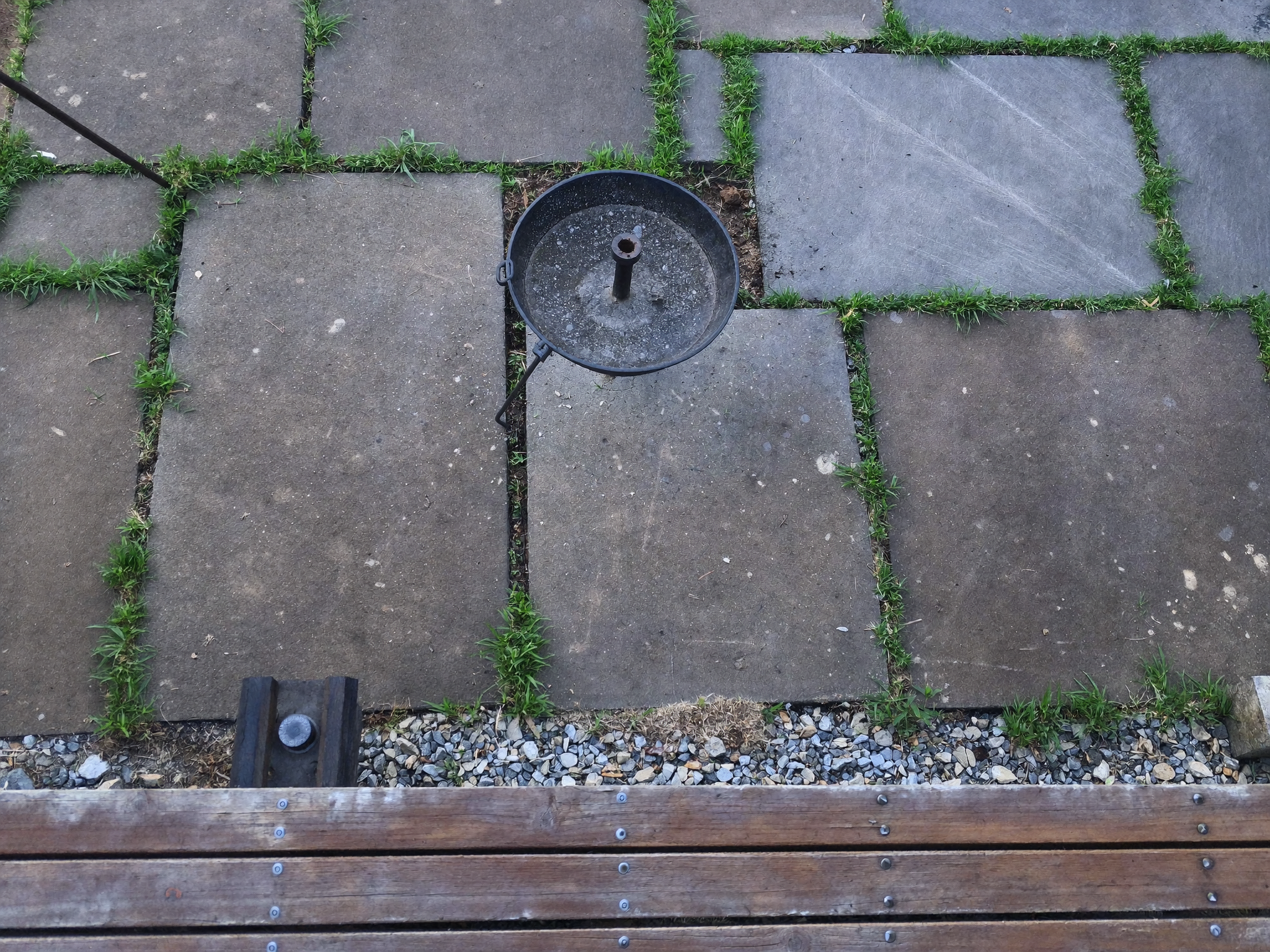
Concrete is noncombustible, but that does not make it immune to fire. Concrete contains moisture and expands unevenly when one small area is heated fast. Research from Oak Ridge National Laboratory explains that elevated temperature can produce cracking and spalling, where pieces break away from the surface. Use a manufacturer-approved stand or heat shield with an air gap, especially with a shallow metal bowl. Do not pour cold water onto hot concrete, pavers, fire glass, or lava rock.
Grass
A fire pit can kill the grass through radiant heat even if no flame reaches it. Dry grass can ignite, and organic material below the surface can continue smoldering after the visible fire is out. Put the pit on a stable, noncombustible pad sized to catch heat and embers, keep the surrounding area clear, and never treat damp grass as a fireproof barrier.
Wood and composite decks
Wood is combustible. Composite boards can soften, discolor, or melt at temperatures far below the flame. Use a fire pit on a deck only if the appliance manufacturer specifically permits that installation, the fuel type and rated barrier meet the instructions, and local rules allow it. Wood-burning pits add escaping sparks and embers to the downward heat problem. Read our full guide to using a fire pit on a deck before placing one there.
A good system combines a noncombustible barrier, enough coverage beyond the bowl, and an air gap that lets heat escape. Follow the fire pit and shield manufacturers' tested clearances instead of improvising from material that merely looks fireproof.
What makes one fire pit hotter than another?
Fuel load and airflow
More burning fuel creates more total heat. In a wood fire, log spacing controls oxygen flow through the pile. Too tight and the fire smolders. Open spacing can support a faster, cleaner burn. NIST's wood-pile experiments found that restricting airflow with a vertical shield reduced the maximum burning rate by more than half.
Wood moisture
Wet wood spends energy boiling off water before the fire can heat the pit and the people around it. The EPA recommends dry, seasoned wood below 20 percent moisture and a small hot start with good airflow to reduce smoke. Our firewood guide explains species, seasoning, and moisture in more detail.
Burner output and design
For gas pits, the regulator, orifice, burner ring, and rated BTU per hour set fuel flow. More output usually means a larger flame field and more total radiant heat, not a radically different chemical flame temperature. Fire glass and lava rock absorb and reradiate heat, but they do not increase the burner's rated output. If you are choosing between fuels, our propane versus natural gas comparison covers cost and installation.
Wind and outdoor temperature
Wind tilts the flame, carries hot gases away, and can direct heat and sparks toward one side. It can make one chair feel cold and another uncomfortably hot. Do not solve a windy night by simply building a much larger wood fire. If flame or embers are being pushed toward combustible material, extinguish the fire.
Smokeless secondary combustion
A double-wall smokeless pit preheats incoming air and burns part of the smoke again near the rim. That secondary combustion can produce an intense ring of flame and hotter walls. It does not eliminate sparks, heat below the pit, or clearance requirements. See how a smokeless fire pit works for the airflow diagram.
How to measure your own fire pit safely
If your real question is whether a specific patio surface is overheating, measure the surface. Do not try to take a flame temperature with a household infrared thermometer. Infrared thermometers read solid surfaces, not the moving combustion gases accurately, and shiny stainless steel can give misleading readings because it reflects infrared energy.
- Read the appliance manual first and identify the required base, stand, and bottom clearance.
- Use an infrared thermometer rated for the expected surface range, aimed from a safe position.
- Record the surface temperature before lighting, then at consistent intervals during a normal burn.
- Check several points below and around the pit because heat can concentrate unevenly.
- Do not lean over the flame, touch the bowl, or move the unit while any part remains hot.
- Stop the test if the surface discolors, smells, smokes, softens, or exceeds the limits in its documentation.
A temperature gun can help reveal a problem, but it does not certify an installation. A listed fire pit used exactly as its manual specifies is more meaningful than a single improvised temperature reading.
The temperature numbers that matter for safety
The hottest possible flame is less useful than the lowest temperature that can injure a person or damage the installation. A NIST heat-exposure analysis models burn injury after skin surface temperature exceeds 55°C, or 131°F. That is tiny compared with a fire pit flame. The lesson is simple: a rim, poker, fire glass bed, or steel side can be cool relative to the flame and still be dangerous to touch.
- Keep the fire pit outdoors and at least 10 feet from the home or anything combustible, following USFA outdoor fire safety guidance unless the manual or local rule requires more.
- Keep children and pets outside the 3-foot safety zone recommended by USFA.
- Use a metal screen over a wood-burning fire to contain sparks.
- Burn only dry, seasoned, untreated wood. Never burn garbage, plastic, or pressure-treated lumber.
- Keep an extinguishing method ready and never leave a fire pit burning unattended.
- Let the pit, media, and ash cool fully before covering, moving, or disposing of anything.
The U.S. Consumer Product Safety Commission warns that alcohol flames can exceed 1,600°F and that refilling a container that is still burning or hot can cause flame jetting. Never pour fuel into a lit or hot unit. Follow the product instructions and current CPSC liquid-fuel fire pit warning.
When the evening ends, do not judge a fire by appearance. Ash can insulate live coals for hours. Follow our step-by-step guide to putting out a fire pit properly, then handle the remains using the fire pit ash disposal guide.
Frequently asked questions
How hot does a wood-burning fire pit get?
The hottest zone of a strong wood fire can reach about 1,000 to 1,200°C, or 1,832 to 2,192°F. Those figures come from NIST measurements inside larger experimental wood piles. A small backyard fire, its steel bowl, and the air at seating distance will not all share that temperature.
How hot does a propane fire pit get?
A propane fire pit does not have one uniform temperature. NIST cites about 1,000°C as a typical maximum for a turbulent diffusion fire and 1,925°C, or 3,497°F, as the maximum premixed propane and air flame temperature. The ideal figure is not the temperature of the table, media, or surface underneath.
Do gas fire pits get as hot as wood fire pits?
Both can create flame regions hot enough to exceed 1,000°C. What you feel depends more on total heat output, flame area, wind, and distance than on the peak chemical flame temperature. Wood output changes with the fuel load. Gas output is regulated and printed as BTU per hour.
Does a higher BTU rating mean a hotter flame?
No. A higher BTU per hour rating means the burner releases more heat energy each hour, usually by burning more fuel across a larger flame area. It does not mean the fuel's flame chemistry has a proportionally higher temperature.
Is 50,000 BTU good for a fire pit?
Yes. A 50,000 BTU per hour fire pit is a solid mid-range choice for many residential patios and equals about 14.7 kW of heat output. Wind, outdoor temperature, seating distance, and burner design determine how warm it feels.
How hot does the bottom of a fire pit get?
There is no universal bottom temperature. It depends on bowl depth, metal thickness, fire size, leg height, air movement, shield design, and how long the pit burns. Treat the underside as capable of scorching grass, damaging pavers, cracking concrete, and softening deck material unless the manufacturer specifies a safe installation.
Will a fire pit crack concrete?
Yes, it can. Concentrated heat creates temperature gradients, and moisture in concrete can contribute to cracking or spalling. Use a manufacturer-approved stand or insulated heat shield with an air gap, and never cool a hot slab suddenly with water.
What should go under a fire pit on grass?
Use a stable, noncombustible, manufacturer-approved fire pit pad or heat shield that extends beyond the hot footprint and catches embers. An air gap is important because a thin mat can still transfer heat. Keep dry grass and other combustible material clear around the pad.
How far should chairs be from a fire pit?
Keep chairs outside the 3-foot safety zone recommended around fire pits, and increase the distance for large wood fires, wind, or combustible furniture. Follow the appliance manual and local rules. People can move closer for comfort, but furniture should never block the required clearance or escape path.
Bottom line
A strong wood fire can exceed 1,800°F in its hottest zone, and propane has an even higher theoretical flame maximum. Those headline numbers do not tell you whether your chair is comfortable or your patio is safe. For real-world decisions, pay attention to total BTU output, distance, wind, the temperature below the pit, and the manufacturer's required barrier and clearances.
The simple rule is to treat every part of an operating fire pit as hot, every spark as capable of starting a fire, and every surface underneath as vulnerable until the installation instructions say otherwise.
Sources
- National Institute of Standards and Technology: Experiments on the Burning of Cross Piles of Wood
- National Institute of Standards and Technology: Personnel Protection Against Heat Exposure
- U.S. Fire Administration: Outdoor Fire Safety
- U.S. Environmental Protection Agency: Burn Wise Health and Safety Tips
- Oak Ridge National Laboratory: The Effect of Elevated Temperature on Concrete Materials and Structures
- U.S. Consumer Product Safety Commission: Liquid-Burning Fire Pit Warning