
The container is almost never the problem. What is on the surface of the metal is the problem, and fire temperature is high enough to do something about it.
Bare steel, stainless, and cast iron are fine. Zinc, paint, powder coating, rubber, and preservative treated wood are not, because a wood fire runs hot enough to vaporize or decompose all of them. Zinc melts near 787 degrees Fahrenheit and boils near 1665, both well inside the range a fire pit reaches. Strip the coating mechanically, never by burning it off, and never cut into a container that held fuel or held pressure.
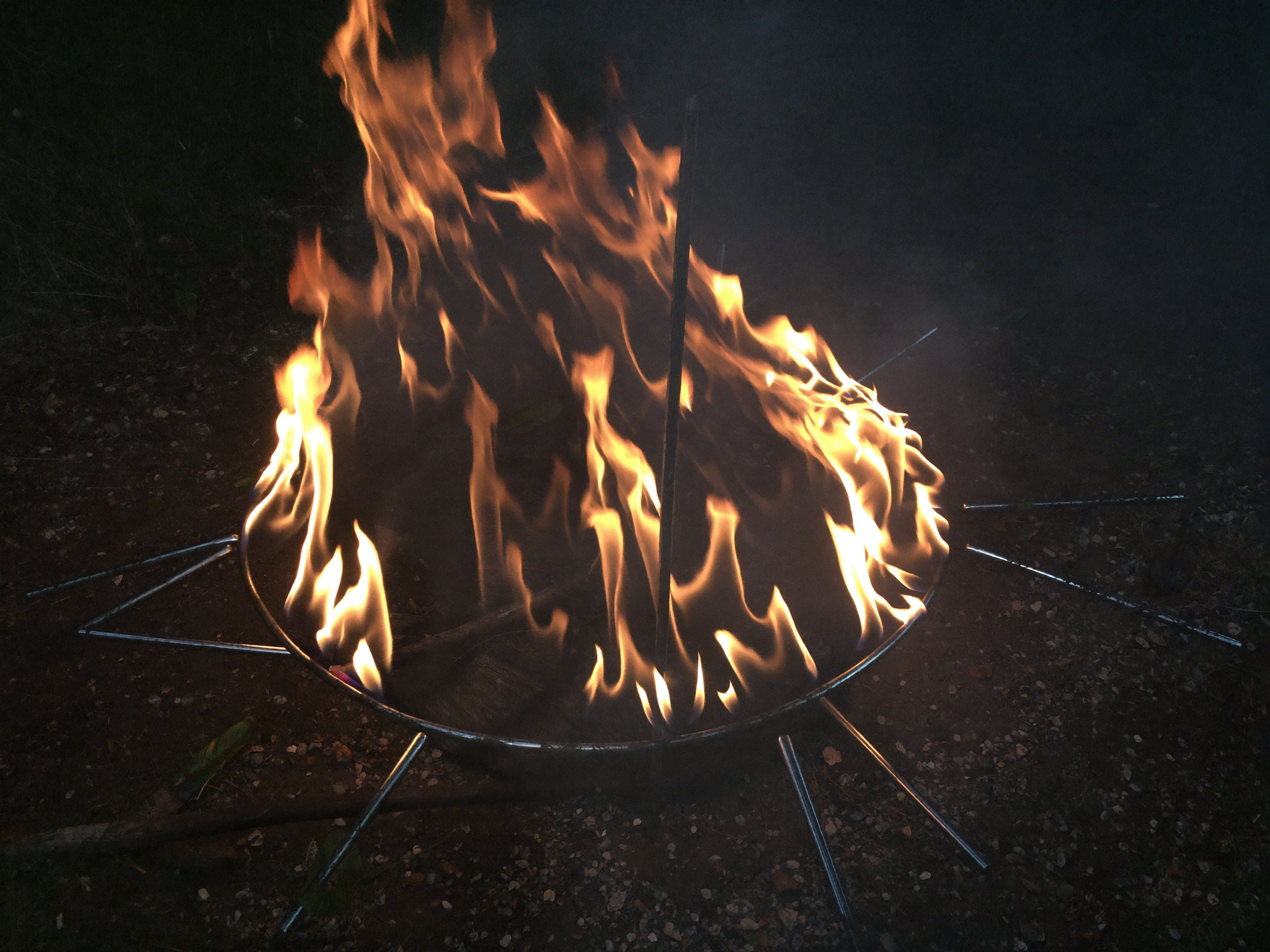
This gives you a starting verdict and a prep list. It does not replace looking the piece over in person, and anything you cannot identify gets treated as coated.
Salvage fire pits are popular for obvious reasons. A drum, a rim, or a bin ring is already the right shape, already thick enough to hold a fire, and usually free. None of the risk in these builds comes from the shape. It comes from a layer a few thousandths of an inch thick sitting on the surface of the steel.
Galvanized steel is the common one. Hot dip galvanizing puts a zinc coating on steel to stop it rusting, and it shows up on washing machine outer tubs, buckets, ductwork, roofing panels, farm containers, and plenty of surplus hardware. Zinc is entirely harmless sitting in your yard. Heated, it is a different material. Zinc oxide fume is the documented cause of metal fume fever, a short, flu-like illness that OSHA and NIOSH both track among welders who cut or weld galvanized steel without ventilation. NIOSH lists the symptoms as chills, muscle ache, nausea, fever, dry throat, cough, weakness, metallic taste, headache, and chest tightness.
It is not usually dangerous from one low exposure and it clears on its own, which is exactly why it gets dismissed in comment sections. It is also completely avoidable by knowing what is on the metal before it goes near a flame. The same logic applies to paint, powder coating, plating, and any plastic liner. Different chemistry, same principle: a coating engineered to sit on steel at room temperature has no reason to behave well at 1,200 degrees.
People argue about whether a backyard fire really gets hot enough to matter. The numbers settle it. Glowing coals sit in the range of 900 to 1,200 degrees Fahrenheit, and the flame zone above burning wood runs hotter still. Zinc melts at 787 and boils at 1,665. Ordinary paints and powder coatings begin breaking down far lower, in the few hundreds. A fire pit is not a controlled oven, and the metal touching the coal bed is the hottest part of the whole assembly.
If a coating exists on the piece, it comes off before the piece sees fire, and it comes off mechanically. Burning it off in the yard is not a preparation step. It is the exposure event itself, performed on purpose, at head height, usually with people standing around watching.
| Material | Verdict | What decides it |
|---|---|---|
| Washing machine inner drum, stainless | Build it | The perforated inner drum is stainless and uncoated. Wash out soap residue and lint, and expect it to discolor. Thin walls mean it is a fire basket, not a lifetime pit. |
| Washing machine outer tub | Leave it | Often galvanized or plastic depending on the machine. If it is the smooth outer shell rather than the perforated basket, it is the wrong part. |
| 55 gallon steel drum, open head | Prep first | Fine only if you know what it held. Strip exterior paint and any interior lining, and confirm it is not galvanized. Cut ventilation holes low on the wall. |
| 55 gallon drum, sealed with unknown history | Leave it | A closed drum with residue inside is a cutting hazard before it is ever a fire pit. Federal hot work rules exist because of exactly this. |
| Surplus ammo can | Prep first | Strip the paint, pull the rubber lid gasket, and remove any liner. Works as a compact portable fire box. Thin steel warps with repeated use. |
| Tractor or truck rim | Prep first | Remove the tire and every scrap of remaining rubber from the bead, then strip old paint. Thick steel makes this one of the most durable salvage options. |
| Brake drum or rotor | Build it | Cast iron, thick, and usually bare except for surface rust. Popular as a small camp or forge fire base. Degrease it first. |
| Grain bin ring or hopper section | Prep first | Frequently galvanized, which is the whole question. Test a spot and strip if the coating is there. Bare sections make a wide, shallow ring. |
| Culvert or heavy pipe section | Prep first | Corrugated culvert is usually galvanized. Heavy black pipe is not. Identify which one you have before cutting. |
| Propane tank, air tank, water heater | Leave it | Pressure vessels holding residual fuel or vapor. Not a driveway project regardless of how the video made it look. |
| Railroad ties and treated timbers | Leave it | Creosote and preservative treated wood. EPA guidance is not to burn it in a residential setting, and a fire pit surround gets hot enough to matter. |
| Cinder block or concrete block | Prep first | Works when the block is dry and the pit is built to vent. Trapped moisture in wet or hollow block is what causes cracking and spalling. |
| Fieldstone or river rock | Prep first | Porous stone pulled from water holds moisture, and moisture turning to steam inside stone is what makes rocks crack apart. Use dry, dense stone. |
| Cast iron pot, pan, or plow disc | Build it | Bare cast iron handles fire indefinitely. Strip any enamel or paint, since enamel chips and flakes when it cycles hot and cold. |
The pattern across that table is worth stating plainly. Every piece in the leave column is there for one of three reasons: a coating that cannot be removed practically, a chemical history that cannot be verified, or stored pressure. Nothing on the list fails because of its shape.
This is where most people get stuck, because the internet keeps recommending a magnet test that does not answer the question being asked. A magnet sticks to galvanized steel and to plain mild steel exactly the same way, since both are steel underneath. What a magnet does tell you is whether a bright, shiny piece is stainless drum material or zinc coated steel, since most washer drum stainless is weakly magnetic at best.
| Check | Galvanized | Stainless | Bare or painted mild steel |
|---|---|---|---|
| Appearance | Dull gray, often with a visible crystal or spangle pattern | Brighter, even surface, no spangle | Red rust where uncoated, or a paint film |
| Magnet | Sticks firmly | Weak pull or none on drum grades | Sticks firmly |
| Grind a test spot | Duller outer skin over brighter steel | Uniform through the cut | Uniform gray under any paint |
| Edges and welds | Coating pools and runs at edges and seams | Clean and consistent | Rust starts at cut edges |
When the checks disagree or the piece is too far gone to read, treat it as coated and strip it. Grinding a piece that turned out to be bare steel costs an hour. Skipping the step on a piece that turned out to be galvanized costs an evening of feeling like you have the flu.
Soaking galvanized pieces in vinegar or muriatic acid does remove zinc, and it also produces hydrogen gas and an acidic waste bath you then have to handle and dispose of. For a fire pit build, mechanical removal is the simpler and more predictable route unless you already work with acids and have somewhere legitimate to put the result.
Propane cylinders, air compressor tanks, water heaters, and any other vessel built to hold pressure sit in their own category. The danger is not the fire. It is the cut. A container that held a flammable liquid or gas keeps residue and vapor in seams and low points long after it looks and smells empty, and the moment a grinder or torch opens it, that vapor has an ignition source.
Federal workplace rules put this in writing. OSHA requirements for welding and cutting state that used containers must be cleaned of flammable material before hot work begins, and shops that convert tanks purge and fill them before a blade ever touches metal. If you genuinely want a tank style pit or smoker, buy one already cut, or pay a fabricator who does the purge as routine.
Fire pits that run on propane are their own topic and a different discussion entirely. If a gas burner is what you actually want, start with our BTU sizing guide and the piece on how long a propane tank lasts on a fire pit rather than modifying a cylinder.
Salvage builds often pair a metal bowl with a timber surround, and that is where treated wood shows up. Creosote treated railroad ties are the common one. EPA classifies creosote as a restricted use wood preservative with no registered residential uses, and its guidance is direct: do not burn creosote or other preservative treated wood in a residential setting. The same applies to older chromated arsenical treated lumber, which puts arsenic into smoke and ash.
For what belongs in the fire once the container is sorted out, see what you can and cannot burn and our guide to firewood species and seasoning.
Once the coating question is settled, the only thing separating a two season build from a ten year one is how much steel is between the fire and the air. Thin material warps, then scales, then burns through at the hottest point, which is usually the base under the coal bed. Thick material shrugs it off.
A salvage pit is judged by the same fire code as a store bought one. The U.S. Fire Administration advises keeping fire pits and outdoor fireplaces at least ten feet from the house or anything that can burn, and keeping children supervised whenever a fire is lit. Local rules frequently go further on container type, size, and burn windows.
If you would rather build with masonry than salvage metal, our guides to building with pavers or brick and using cinder blocks cover the moisture and spalling questions in depth.
Plenty of people find this page after the first burn, when the drum turned out to be galvanized and everyone standing around it woke up feeling rough. What NIOSH describes is a short, self limiting illness: chills, aches, fever, cough, a metallic taste, headache, and chest tightness, typically appearing several hours after exposure and clearing within a day or two. It is unpleasant rather than lasting, and it does not build up into something chronic from one backyard evening.
That said, the sensible steps are simple. Get into fresh air, stop using the container, and get medical advice if breathing is difficult, if symptoms persist beyond a couple of days, or if a child or someone with a lung condition was exposed. Poison control in the United States takes calls around the clock at 1-800-222-1222. Then strip the piece properly or replace it, because the second burn does the same thing as the first.
Not with the zinc left on it. Zinc melts near 787 degrees Fahrenheit and boils near 1,665, both inside the range a wood fire reaches. The perforated inner drum most people are picturing is stainless and has no zinc on it, which is why that version of the build is common and fine. The smooth outer tub is the one to leave in the scrap pile.
Galvanized is dull gray, often with a crystal pattern, and a magnet grabs it hard. Drum stainless is brighter and only weakly magnetic. A magnet cannot separate galvanized from plain steel since both are magnetic, so grind a test spot and look for a duller skin over brighter metal.
No. That is the exposure event, not the prevention step. Take it off with a wire cup brush or flap disc, or have the piece sandblasted.
Yes, once the paint is stripped and the rubber lid gasket and any liner are out. It makes a compact portable fire box. The steel is thin, so expect warping over a couple of seasons.
They are among the most durable salvage options because the steel is thick. Every scrap of tire rubber has to come off the bead first, along with old paint. EPA testing on open burning of scrap tire material found emissions many times more mutagenic than burning wood.
Not at home. These are pressure vessels holding residual fuel or vapor, and cutting one that has not been purged is how people get hurt. Federal rules require used containers to be cleaned of flammable residue before any cutting or welding. Buy one already cut or pay a shop.
Creosote treated wood has no registered residential use and EPA guidance is not to burn it in a residential setting. A surround that sits close to a fire gets hot enough for that to matter, so use stone, block, or untreated timber instead.
Porous stone that has been sitting in water can crack apart when trapped moisture turns to steam. River rock pulled from a creek bed is the classic offender. Use dry, dense stone, and give any masonry build a way to vent.
Wall thickness decides it. A drum or ammo can gives you a season or two of regular use, a quarter inch rim or a cast iron brake drum lasts for years. Drainage holes and clearing ash between burns extend all of them.
FirePitSpot is reader supported and may earn a commission from qualifying purchases linked from this site. This page is general reference on materials and is not an endorsement of any specific build. Temperature and thickness figures are approximate and vary by manufacturer, fuel, and how a fire is run.